I. The Concept of Biological Breadth
In 1961, Gargiulo et al. conducted research by measuring the widths of various parts at the gingival-tooth junction in cadaver specimens of normal individuals. The average results were as follows: the gingival sulcus depth was 0.69 mm, the epithelial attachment length was 0.97 mm, and the width of the connective tissue above the crest was 1.07 mm. Although these three structures exhibited considerable variation in values, the measurements of the crestal connective tissue remained the most consistent. These average measurements formed the basis of the biological width. Typically, the constant distance from the bottom of the gingival sulcus to the crest of the alveolar ridge is referred to as the biological width (BW), encompassing the junctional epithelium and the gingival connective tissue above the alveolar crest, with a width of approximately 2 mm. As age increases or under pathological conditions, the junctional epithelial attachment migrates apically, and the alveolar crest also descends accordingly. However, the biological width between the sulcus (pocket) bottom and the crest remains unchanged.
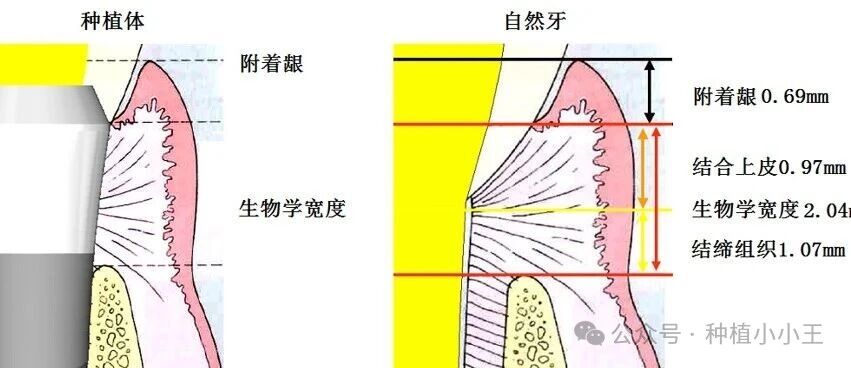 II. The Significance of Biological Breadth
1. The function of the biological width is to protect the vulnerable gingivo-dental junction, which can be understood as the width of the defensive wall surrounding the teeth.
2. The gap around the teeth or implants (with the gums) is a vulnerable structure through which bacteria and other pathogens in the oral cavity can directly invade. To prevent these issues, a certain thickness of soft tissue defense membrane must be maintained.
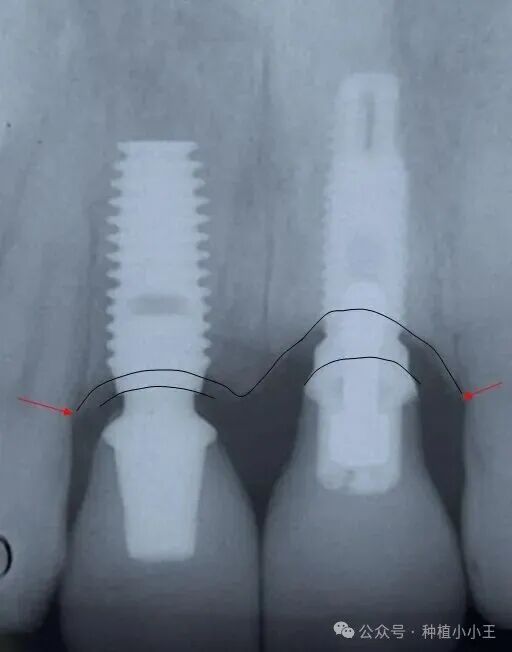
3. The implant abutment interface is surrounded by soft tissue, and research has shown that the soft tissue attached to the implant abutment interface has many similarities with the gingival tissue structure. There is also a biological width similar to natural teeth around the implant, which requires the mucosa around the implant to reach a certain thickness and height to ensure that the formed combined epithelium and gingival connective tissue are sufficiently enclosed around the implant to avoid invasion by external mechanical factors and internal biological factors.
4. The difference between natural teeth and dental implants is that natural teeth form direct adhesion due to the attachment of epithelium, while dental implants cannot directly adhere and only adhere to the surface of the implant. Berglundh and Lindhe believe that the minimum width of the mucosa around the implant is approximately 3mm to create a biological width around the implant.
5. If the thickness of soft tissue is artificially reduced, the alveolar bone will absorb to maintain its original soft tissue thickness.


